
150%, 180%, or 200% Wig Density?
Wig density describes how full a wig is intended to look, but the percentage does not tell the whole story. Texture, length, layers, cap construction, hairline density, and even the seller's own measuring system can change how full a wig actually appears.
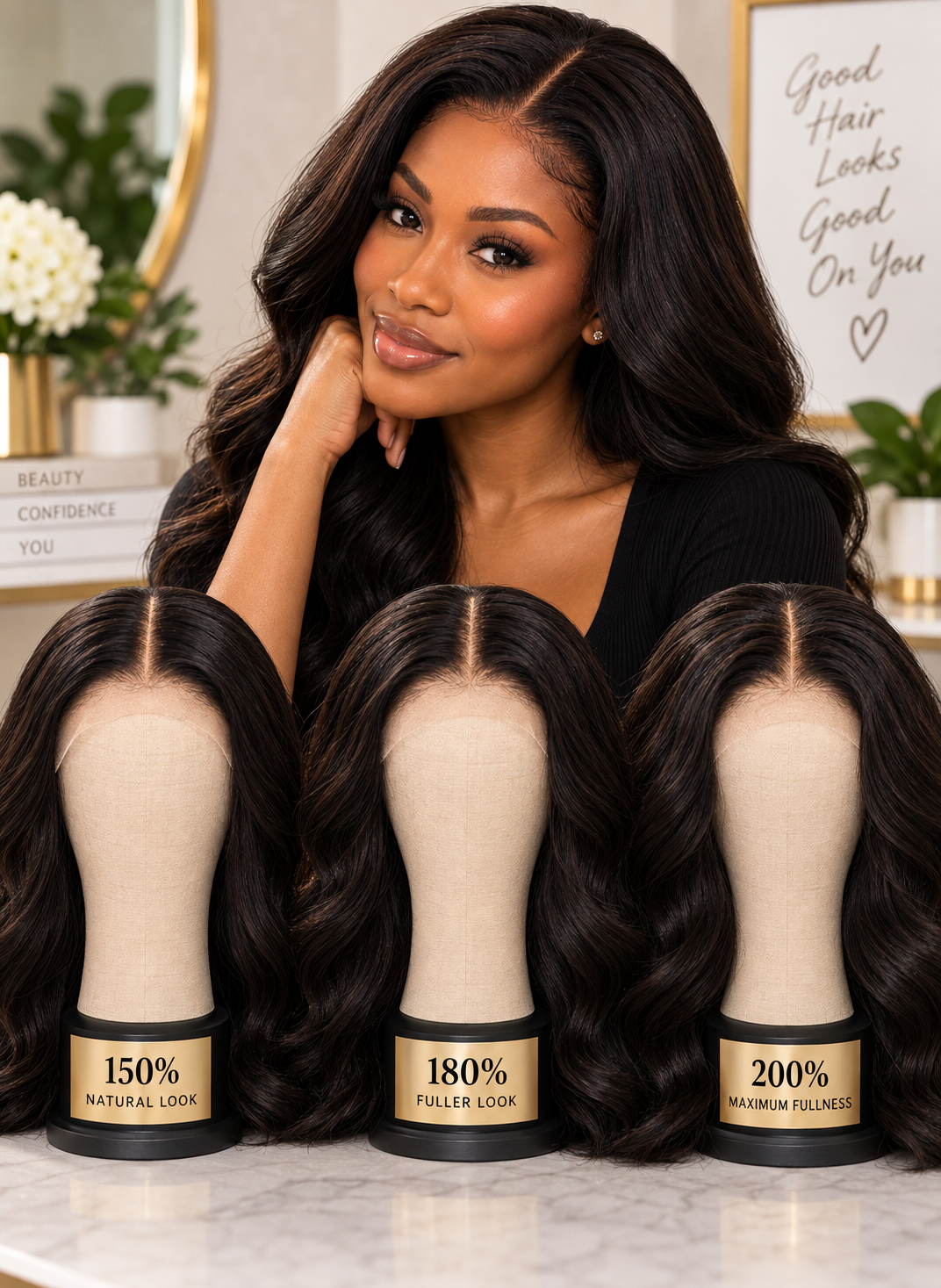
150% density is commonly positioned as a lighter or more natural-looking fullness.
180% density usually creates a fuller look while still being practical for many everyday styles.
200% density is generally intended for noticeably fuller, heavier, or more dramatic hair.
These numbers are useful guides, not universal measurements. One seller's 180% can look different from another seller's 180%.
Density is one of the most misunderstood numbers on a wig listing.
Wig density is used to describe the overall amount of hair and the fullness the seller intends the wig to have.
The problem is that there is no single consumer-facing standard that guarantees every manufacturer distributes and labels density exactly the same way.
That means a 180% body-wave wig from one seller may appear fuller or lighter than another 180% wig.
Texture, length, layering, end thickness, hairline density, and where the hair is concentrated across the cap can all change the result.
150%, 180%, and 200% density.
Think of the percentages as general fullness categories rather than exact promises about how much hair you will see.
150% Density
150% is commonly marketed as a more moderate or natural-looking density.
It can work particularly well for shorter styles, bobs, straight wigs, and women who do not want a large amount of hair.
Think: lighter, easier movement, less bulk.
180% Density
180% is commonly chosen by shoppers who want noticeably full hair without automatically moving into the heaviest density range.
It can work across straight, body-wave, curly, kinky-straight, medium, and long styles.
Think: fuller appearance with broad styling flexibility.
200% Density
200% is generally aimed at shoppers who prefer substantial volume, dramatic styling, or more hair throughout the wig.
Longer lengths may benefit visually from additional fullness, but the extra hair can also increase weight and maintenance.
Think: dramatic volume, more hair, potentially more weight.
A 180% curly wig can look much fuller than a 180% straight wig.
Straight hair generally lies closer together, which can make the overall silhouette appear sleeker.
Body wave and deep wave create more visual space and movement. Curly, kinky-curly, coily, kinky-straight, and Afro-textured wigs may appear substantially fuller because the texture expands outward.
For women who enjoy natural-hair-inspired textures, the number on the listing may therefore matter less than customer photos showing the actual shape and volume.
Density looks different at 12 inches than it does at 28 inches.
A shorter 150% bob can appear quite full because the hair is concentrated within a smaller silhouette.
On a very long wig, the same stated density may look lighter through the lower lengths, particularly when the wig is layered or the ends are naturally tapered.
This is one reason some shoppers prefer higher density in longer wigs.
But full density at the crown does not guarantee thick ends. Customer photos can help reveal whether the bottom of the wig looks full or noticeably thin.
A full wig can still have a softer, more believable hairline.
The front hairline should not necessarily be packed as densely as the rest of the wig.
A gradual transition from a softer front into fuller hair can create a more natural appearance around the face.
Pre-plucking, knot size, lace color, parting, baby hairs, and how the front is ventilated all contribute to the final effect.
A 200% wig with an extremely dense front may require more customization than a similarly full wig with a graduated hairline.
A 200% wig is not inherently better than a 150% wig. It simply aims to provide more fullness.
Choose density according to texture, length, styling preference, comfort, climate, maintenance, and how much volume you actually enjoy wearing.
Hair quality, lace, construction, fit, end quality, and shedding matter independently of density.
Fullness has a practical side.
Higher-density wigs contain more hair, which can increase the amount of weight sitting on the cap.
More hair may also take longer to wash, condition, dry, detangle, and restyle.
In warm weather, very dense wigs may feel hotter to some wearers, particularly at longer lengths.
Women who prioritize lightweight everyday wear may prefer moderate density even when they like the appearance of very full hair.
“Natural” does not always mean low density.
Natural hair comes in many densities, textures, lengths, and shapes.
A woman with naturally thick Type 4 hair may find a fuller kinky-straight or Afro-textured wig believable, while another wearer may prefer a sleeker 150% straight unit.
African American women, African women, textured-hair wearers, and women of color should not be pushed toward one arbitrary density as the only natural-looking choice.
The goal is a density that looks convincing to you and works with the style you want.
Quick look at 150%, 180%, and 200%.
| Density | General Look | Often Considered For | Watch For |
|---|---|---|---|
| 150% | Lighter to moderate fullness. | Everyday styles, bobs, shorter lengths, sleek looks. | Very long styles may look lighter through the ends. |
| 180% | Full without necessarily being extreme. | Medium and long styles, waves, curls, versatile everyday wear. | Texture can make it appear much fuller than expected. |
| 200% | High fullness and volume. | Long styles, dramatic looks, shoppers who enjoy substantial hair. | Weight, heat, maintenance, dense hairline. |
Check more than the percentage.
Density is useful, but the listing should give you enough evidence to understand how the actual wig is likely to look.
Customer Photos
Real-world images can reveal whether the stated density matches the fullness you expect.
Texture
Curly, kinky, coily, and wavy textures can visually amplify density.
Length
Longer wigs distribute the hair across more inches and may look different through the ends.
End Fullness
Check whether the ends remain substantial or taper significantly.
Hairline
A very full wig should still have a front density that works with the look you want.
Seller Consistency
Repeated customer comments about thin or inaccurate density deserve attention.
Density works together with texture and length.
Use these guides to narrow the overall look before choosing a percentage.
Wig Textures
See how straight, wavy, curly, kinky, coily, and Afro-textured wigs create different amounts of visible volume.
Texture GuideWig Lengths
Understand how short, medium, and long wigs distribute fullness differently.
Length GuideLong Wigs
See how length, end quality, density, weight, and tangling interact on longer units.
Long Wig GuideKinky Straight Wigs
See why textured straight wigs can appear fuller even without choosing the highest stated density.
Kinky Straight GuideWigs by Budget
Understand how density, length, hair type, lace, and construction can influence price.
Budget GuideWig Reviews
Browse research-based reviews with product claims and customer-reported experiences clearly separated.
Browse ReviewsCommon questions about choosing wig fullness.
What does 150% wig density mean?
It is a seller's stated level of wig fullness and is commonly positioned as a lighter or moderate density. The exact appearance can vary by manufacturer, texture, length, and construction.
Is 180% density good for everyday wear?
It can be. Many shoppers choose 180% when they want fuller hair without automatically selecting the highest-density option. Texture, length, climate, and personal preference should still be considered.
Is 200% density too much?
Not necessarily. It depends on the desired style. Some wearers enjoy substantial volume, particularly with long or dramatic styles, while others may find the extra hair heavier than they want for everyday wear.
Does higher density make a wig better quality?
No. Density describes fullness. Hair quality, lace, construction, fit, shedding, processing, end quality, and other factors must be evaluated separately.
Which looks more natural: 150% or 180% density?
Either can look natural depending on texture, length, layers, hairline density, styling, and the wearer's preferred amount of fullness.
Does curly hair need lower wig density?
Curly and textured wigs often appear fuller at the same stated density because the hair expands outward. That does not mean a particular percentage is required; it means texture should be considered alongside the number.
Choose the fullness you want to wear—not the biggest number on the listing.
Consider texture, length, hairline, end fullness, weight, climate, maintenance, and customer photos before deciding between 150%, 180%, and 200% density.